
Buddy the Unicorn Costume Trend, Explained
Why the haunted unicorn mascot became a 2026 Halloween trend, how to build an original look, and how to avoid copying a licensed character or costume design.
On this page
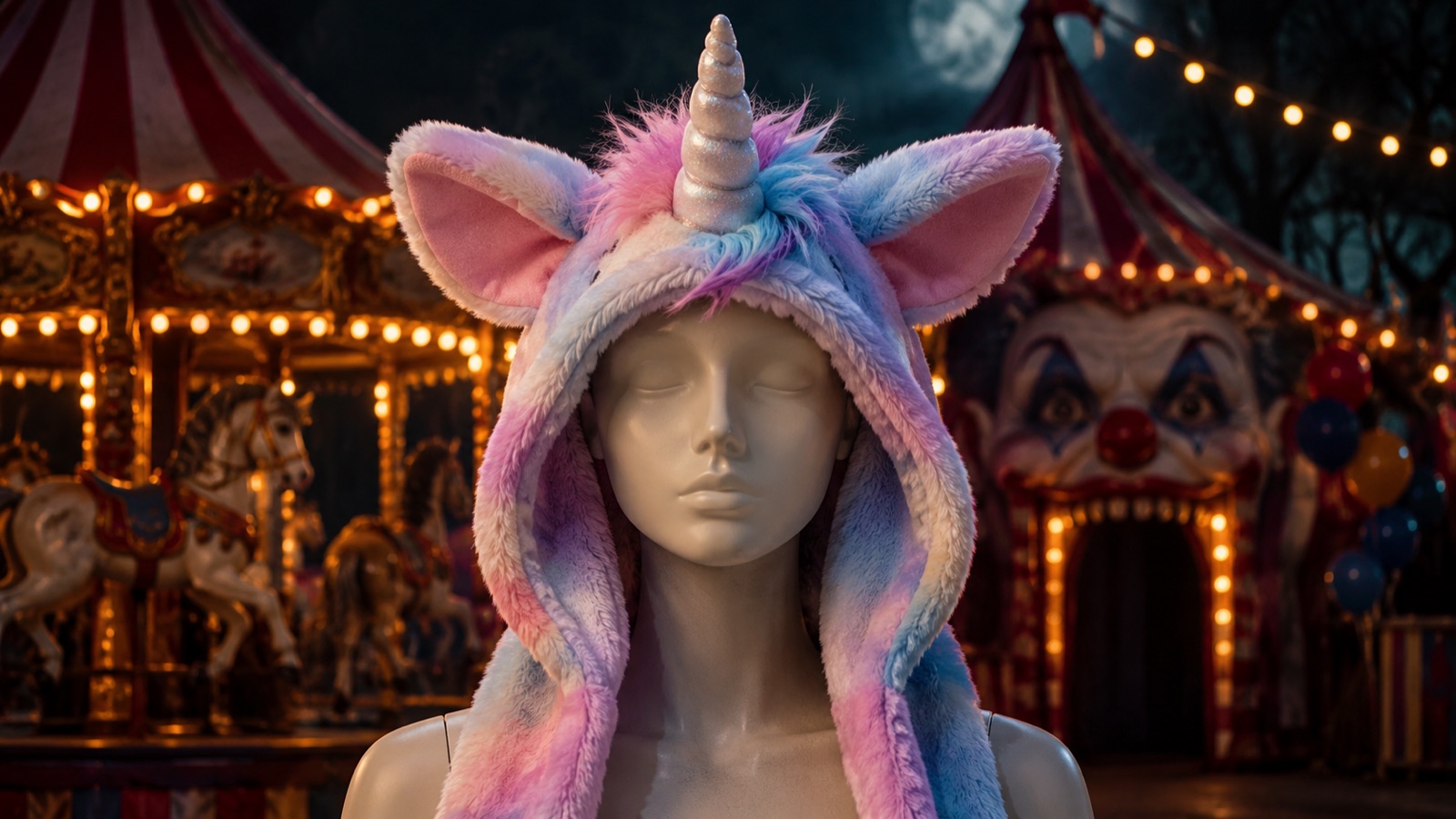
Short answer: Buddy the Unicorn is a 2026 Halloween costume trend built around a haunted unicorn mascot: a pastel children-party surface with a horror-movie mood. You can use the visual ingredients — a plush hood, a spiral horn, a dark carnival scene — to build an original look without reproducing a film character or a specific costume product.
Trend lists are useful for one thing: they tell you what people are already searching for. They are not permission to copy a design. The Buddy the Unicorn story is a good example of the gap between a trend and a product.
What the trend actually is
Halloween retail coverage in 2026 put a unicorn mascot costume near the top of the adult rankings. The look is a contradiction: a soft pastel mascot head, a single spiral horn, and a children's party palette, staged like a horror scene. The joke is the mismatch.
The trend is connected to a 2026 horror film named Buddy, according to the retail roundups that tracked the costume. Treat that as context, not as a license. A film character, a costume design, and a generic unicorn mascot are three different things, and only one of them is safe to generate freely.
Why it spread
Three things made the look travel:
- It is readable in a thumbnail. A pastel horn against a dark background reads instantly, even on a phone.
- It is easy to remix. You do not need a full mascot suit. A hood, a horn headband, or a pastel mane is enough to signal the trend.
- It is funny and unsettling at once. That combination performs well in short-form video, where a single strong image is the whole hook.
The remixability is also the risk. When a look is easy to copy, everyone copies the same reference, and the result drifts from "inspired by" to "replica". If you are making a costume, a photo, or a page, decide early which side of that line you are on.
The visual ingredients, separated from the character
An original haunted-unicorn look can use these ingredients:
- Surface: soft pastel plush, fleece, or felt. The material should look touchable.
- Horn: a single spiral horn, slightly oversized, in pearl, silver, or iridescent finish.
- Silhouette: a hood or a mane, not a full face mask. Keep the human face visible.
- Scene: a dark carnival, a foggy fairground, or a dim party room with warm bulbs.
- Light: warm practical lights against a cool ambient fill. The contrast is the mood.
- Color: pastel pink, lavender, mint, and cream against charcoal and black.
None of those ingredients belong to a single film. They are a genre vocabulary. You can combine them in your own proportion and call the result an original haunted-unicorn concept.
What not to copy
Do not ask an image model to reproduce a specific film character, a named costume product, or a studio logo. Do not upload a copyrighted costume photo and ask for a one-to-one copy. Do not sell a generated image as official merchandise or imply an endorsement.
This is not just a legal caution. A replica prompt usually produces a worse image: the model has to match a specific design it does not know precisely, so it averages the details and returns something that looks neither original nor accurate. An original prompt gives the model room to make a coherent picture.
How to generate an original look
The Buddy the Unicorn costume generator has six presets, from a full plush mascot hood to a hair-only rainbow mane. Each prompt follows the same structure:
- Preserve the face, skin tone, and body proportions.
- Change the costume with concrete nouns: plush hood, spiral horn, ribbon collar.
- Place the subject in a specific scene: dark carnival tent, pastel bedroom, charcoal studio.
- Light the scene with one key source and one fill.
- Avoid a mascot mask that covers the face, changed identity, extra limbs, text, and watermarks.
The "keep the face visible" instruction is deliberate. A full mascot head hides the person, which makes the portrait less useful and gives the model less identity information to preserve. A hood pushed back, a horn headband, or a mane edit keeps the face in the frame.
Source photo tips
A front-facing portrait with the shoulders visible gives the model room for a hood or a collar. A tight face crop leaves nowhere for the costume to go. Step back half a meter and take the photo again.
Avoid a busy background. The presets add their own scene, and a complex source makes the edge between hair and background harder to replace. A plain wall is enough.
If you want a couple or a pet version, use the couple costume generator or the pet costume generator. The unicorn presets are written for one person.
AI preview vs a real costume
A generated image is a preview of a direction, not a sewing pattern. It can show you whether a pastel horn and a dark carnival scene work with your face and coloring. It cannot tell you how a real plush hood will fit, how hot it will be, or whether the seller's sizing chart is accurate.
If you plan to buy or make a costume, use the image for color, silhouette, and material ideas, then check a real seller's size chart and return policy. If you are making it yourself, treat the image as a mood board, not a technical drawing.
Why this page exists
The search demand around a trend name is real, but the useful answer is not "buy this exact costume". It is "here are the ingredients, here is how to make an original version, and here is what not to copy". That is the difference between a trend page that helps someone and a trend page that just repeats a product name.
The 2026 window is short. Halloween pages should be useful before the date, and they should stay online afterward with updated information rather than being deleted. The same URL can serve next year's version of the trend.
Frequently asked questions
Is this an official Buddy the Unicorn costume generator?
No. It is an independent image-editing page that generates original haunted-unicorn concepts. It is not affiliated with the film, its studio, or any costume seller, and it does not reproduce a licensed character design.
Can I generate the exact costume from the film?
No. The presets are original looks built from generic visual ingredients. Asking a model to reproduce a specific character design can create intellectual-property problems, and the result is not an official costume anyway.
Why do the prompts keep the face visible?
A full mascot head hides the person and makes the portrait less useful. Keeping the face visible also gives the model a stable identity reference, which reduces warping and face changes.
Can I use the image as a reference for a real outfit?
Yes, as a visual reference for colors, materials, and silhouette. It is not a sewing pattern and does not guarantee that a real costume will fit or look the same. Check a real seller size chart before buying.
Try an original look
Open the Buddy the Unicorn costume generator and start with the Haunted Unicorn Mascot preset. If you want a softer edit, choose Glitter Horn Portrait or Rainbow Mane. If you want the full prompt library, open Halloween AI prompts.
Further reading
- Fair use — the U.S. Copyright Office explainer on reusing a character or costume design.
Related guides
How to Turn a Selfie Into a Halloween Costume
A step-by-step guide to turning a selfie into a Halloween costume portrait with AI: source photo, costume prompt, identity preservation, and model choice.
ReadBest Halloween AI Prompts for 2026
12 Halloween AI prompt formulas for portraits, couples, pets, backgrounds, and short videos, with the exact preserve-change-light-avoid structure that works.
ReadHalloween Couple Costume Ideas You Can Preview
Eight coordinated couple costume ideas, the contrast rule that makes them read in a photo, and a multi-reference AI workflow for previewing both looks together.
Read